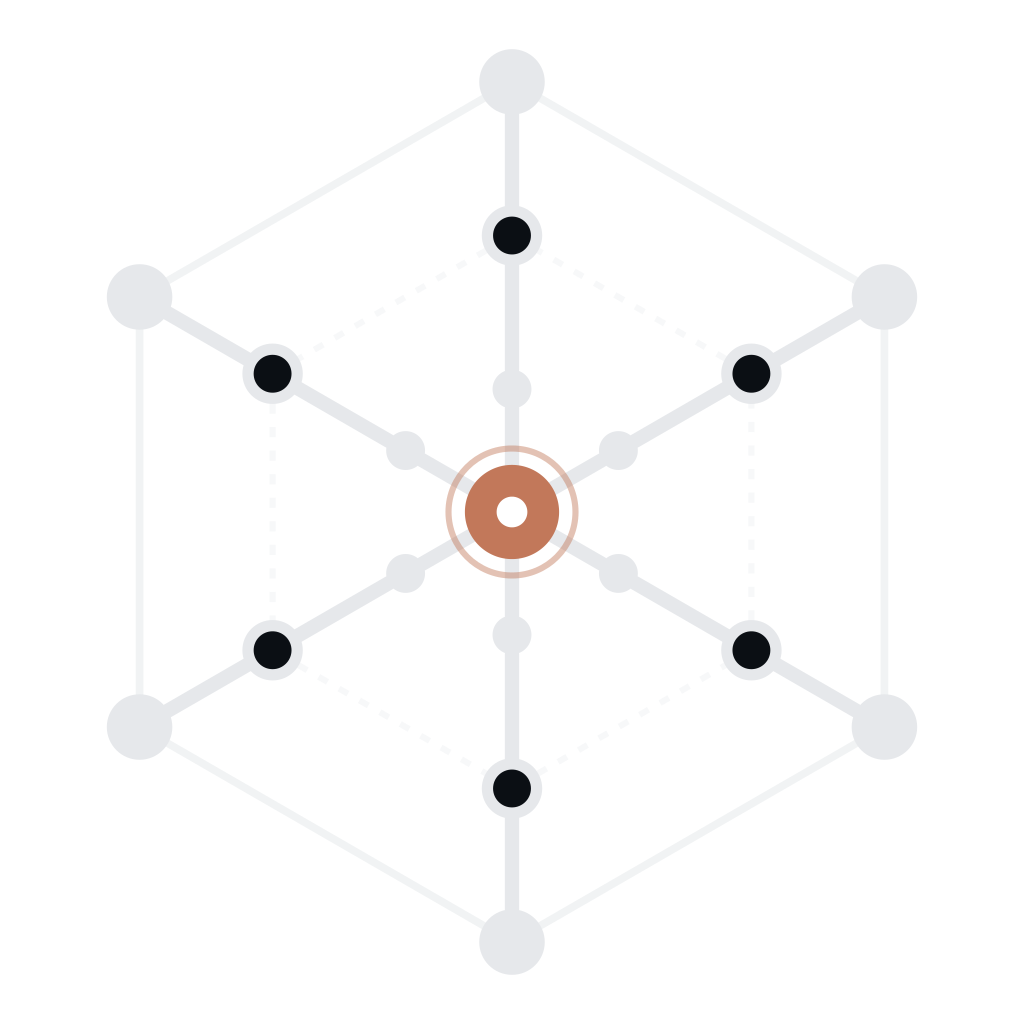

Sovereignty, residency and localisation are not synonyms
Malaysia launched its National Cloud Computing Policy in August 2025 to support a sovereign, secure, inclusive and sustainable cloud ecosystem. The policy states that data generated in Malaysia remains subject to Malaysian law regardless of where it is physically stored or processed.
It does not impose blanket localisation. Most data has no general residency requirement, while specific regulated or sensitive categories may need additional safeguards. A credible sovereign-AI strategy must therefore begin with classification and control—not a map pin.
◇Data location is one control. Sovereignty is the continuing ability to decide, enforce and prove.
Build sovereignty across five layers
Legal sovereignty defines the applicable jurisdiction, contracts and obligations. Data sovereignty covers classification, purpose, encryption, access and transfer. Infrastructure sovereignty covers deployment, keys, networks, backups and operational access.
Model sovereignty preserves real provider choice and an exit path. Operational sovereignty keeps identity, permissions, organisational memory, approvals and evidence under the organisation’s authority even as models change.
- Legal: applicable law, processor duties and enforceable contracts.
- Data: classification, minimisation, encryption and transfer controls.
- Infrastructure: deployment, keys, networks, backup and support access.
- Models: approved registry, routing policy and provider portability.
- Operations: scoped memory, human authority and reconstructable actions.
Keys, access and memory can matter more than location
A locally hosted workload is not meaningfully sovereign if a third party controls its encryption keys, unrestricted support access or the only copy of its activity evidence. Conversely, a carefully governed external model can be used for an approved task without transferring the organisation’s entire memory layer.
Retrieve only the minimum permitted context, apply identity and policy before each model call, and retain durable knowledge and audit evidence in infrastructure the organisation controls.
◇The model may be temporary. Organisational memory, permissions and evidence must remain durable.
Use multiple models without fragmenting governance
A Malaysian organisation may use a self-hosted model for sensitive extraction, a local model for language or cost-sensitive work, and an external frontier model for complex reasoning. The control model should not change with the provider.
Intelligent routing should select only from approved models, explain the route, respect data policy and preserve the same citations, permission checks, approval gates and activity record.
- Can sensitive tasks be forced to a self-hosted model?
- Can model routes be constrained by data class and jurisdiction?
- Can administrators see exactly what context left the boundary?
- Can the complete evidence record be exported independently?
Test sovereign-AI claims before procurement
Ask for a current data-flow diagram, subprocessor list and operational-responsibility map. Verify who controls encryption keys, where support staff may connect, how deletion reaches backups and whether denied retrievals and transfers appear in the audit trail.
Then run one real boundary test across two roles and two model routes. A sovereign architecture should preserve the same permissions and evidence through every path.
Official references.
These field notes interpret official materials for enterprise teams. They are not legal advice.